
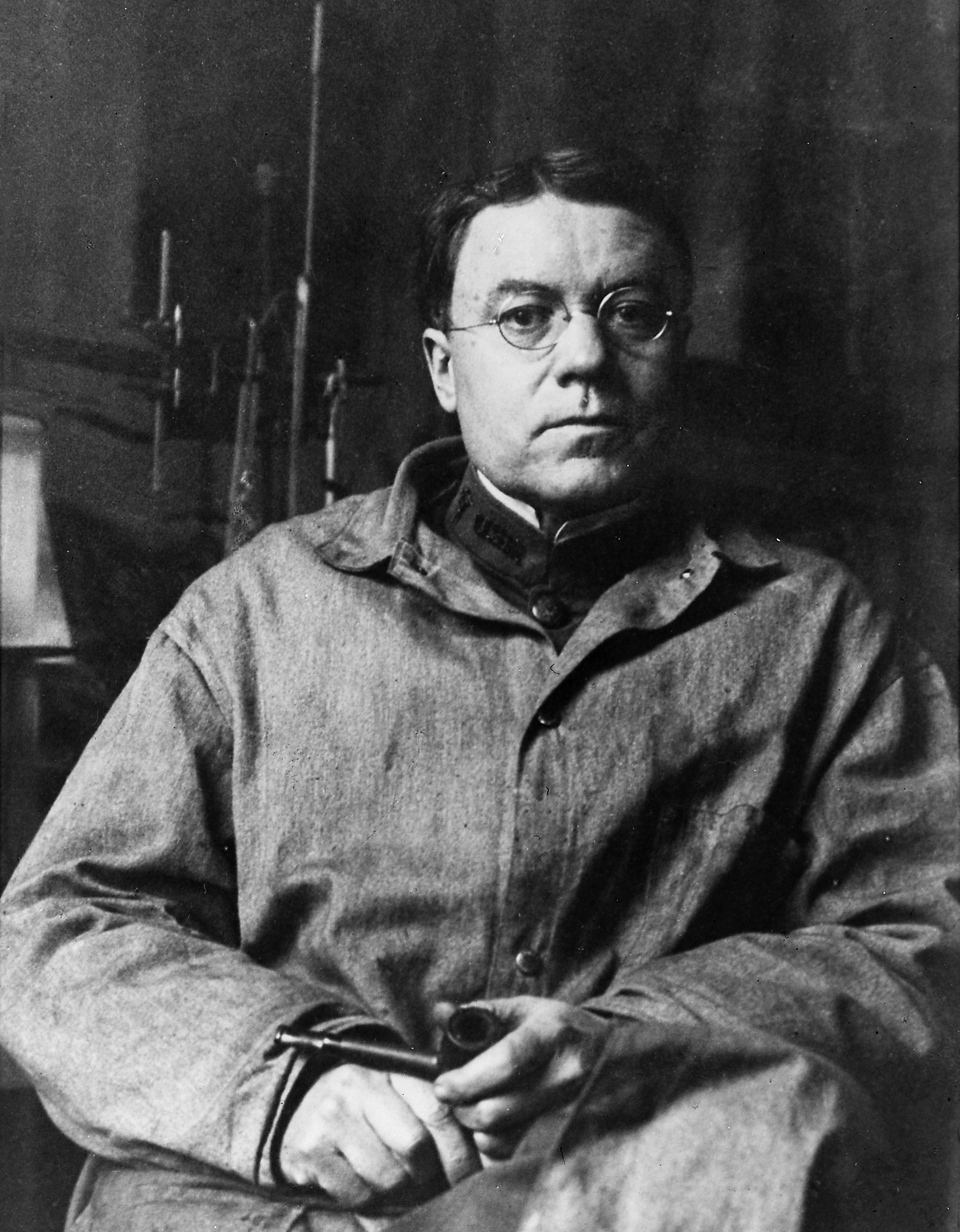
CANNON, Walter Bradford (1871 – 1945)
1871 – 1945
11 entries in the GMN corpus.
Image source Unknown author Unknown author · [1] · CC BY 4.0
1898 CE
#2687.1
The movements of the stomach studied by means of the Roentgen rays.
Cannon introduced the bismuth meal. He showed that bismuth, opaque to x rays, could be of great use in conjunction with roentgenology in the investigation of the digestive tract. See No. 1029.
1905 CE
#12457
Auscultation of the rhythmic sounds produced by the stomach and intestines.
Cannon reported on the rhythmic sounds made by the GI tract, mostly basing his observations on his own abdomen. This may be the first serous study of this topic.
1911 CE
#1029
The mechanical factors of digestion.
Summarized research begun in 1896. See No. 3519.
1915 CE
#1124
Bodily changes in pain, hunger, fear, and rage. An account of recent researches into the function of emotional excitement.
Observation of the effect of strong emotions on gastrointestinal motility (No. 1029) led Cannon to examination of the sympathetic nervous system and its emergency function. Cannon showed the close connexion between th…
1915 CE
#3848
Experimental hyperthyroidism.
First successful experimental production of exophthalmic goitre. With C. A. L. Binger and R. Fitz.
1923 CE
#11567
Traumatic shock.
"In the fall of 1916, before the United States entered World War I, the National Research Council named Cannon a member of a committee on traumatic shock. Later he joined the Harvard University Hospital Unit. On his w…
1931 CE
#1346
Studies on conditions of activity in endocrine organs. xxvi. A hormone produced by sympathetic action on smooth muscle.
Cannon and Bacq suggested the name “sympathin” for a substance which they considered to be liberated into the blood stream following nerve stimulation and which acted in the same manner as sympathetic impu…
1932 CE
#664
The wisdom of the body.
A discussion of the regulation of body fluids, hunger, thirst, temperature, oxygen supply, water, sugar, and proteins of the body, and the role of the sympathetic-adrenal mechanism.
1933 CE
#1350
Studies on conditions of activity in endocrine organs, xxix. Sympathin E and sympathin I.
Adrenaline and sympathin were suggested to be unidentical substances, and Cannon and Rosenblueth proposed the terms “sympathin E” and “sympathin I”.
1934 CE
#1580
The story of the development of our ideas of chemical mediation of nerve impulses.
1937 CE
#1354
Autonomic neuro-effector systems.
The authors hypothesized the existence of two sympathins, one excitatory and the other inhibitory, now known as epinephrine and norepinephrine. See Nos. 1144 & 1350.