
Figura ductus cuiusdam cum multiplicibus suis ramulis noviter in pancreate in diversis corporibus humanis observati.
Publication Details
Padua, 1642 CE.
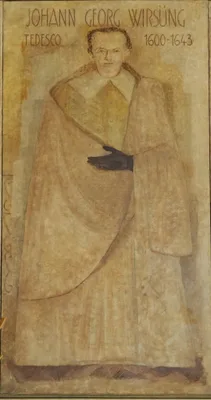
Wirsung, assistant to the celebrated German anatomist Johann Vesling, discovered the excretory duct of the pancreas named for him in 1642. To announce his discovery, Wirsung chose the extremely unusual method of publishing a single-sheet engraving with explanatory notes. On August 23, 1643, a year after publishing his plate, Wirsung was assassinated by a doctor from Dalmatia. Very few copies of Wirsung's print survived. Erik Waller owned a copy now at the University of Upsalla, listed as item 10362 in the catalogue of Waller's library, and illustrated as plate 48 in that catalogue. A different version of the plate was issued in Amsterdam in 1644 with the title Pancreatis, novique in eo ductus seu vasis a Io. Georgio Wirsung observati. . . . The creator(s) of the 1644 plate, while familiar with Wirsung's discovery, may never have seen the original 1642 plate as the images are quite different. Wirsung's plate focuses on the ductus pancreaticus, and is fairly simple and schematic, while the Amsterdam plate shows the pancreas in its entirety, and is much more artistic in its rendition. The Wikipedia reproduces an image of the 1644 plate at this link.
Browse Tags
Thematic Classifications
| Catalog Metadata | Reference Information |
|---|---|
| Entry Number | #7879 |
| Permanent Link | https://hom-sveltekit.fly.dev/entry/10051 |
| Author Bio Link | Wikipedia ↗ |
| External URL | figura-ductus-cuiusdam-cum-multiplicibus-suis-ramulis-noviter-in-pancreate-in-diversis-corporibus-humanis-observati |
Geographic Context
Publication place: Padua
Mentioned in annotation: Amsterdam