
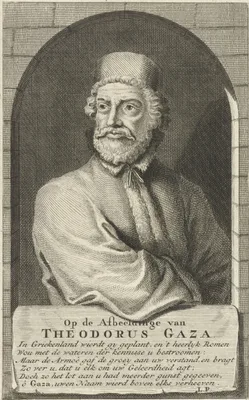
De animalibus. Translated by Theodorus Gaza. Edited by Ludovicus Podocarthus.
Publication Details
Venice: Johannes de Colonia and Johannes Manthen, 1476 CE.
Includes Aristotle's De historia animalium, De partibus animalium, and De generatione animalium. Aristotle was the first scientist to gather empirical evidence about the biological world through observation. By his careful observations and excellent accounts of the natural history of those living creatures which he was able to investigate in De historia animalium Aristotle may be considered the first scientific naturalist. English translation in his Works...edited by J. A. Smith and W. D. Ross, Oxford, 1910, vol. 4.
Aristotle's De partibus animalium is the first animal physiology. English translation in his Works edited by Smith and Ross, vol. 5. That edition excluded annotations by the translator, William Ogle, that were published in the edition of London, 1882.
Aristotle's De generatione animalium is the first textbook on embryology. "The depth of Aristotle's insight into the generation of animals has not been surpassed" (Needham). English translation in his Works, edited Smith & Ross, vol. 5. Later translations are also available.
Digital facsimile from Bayerische StaatsBibliothek at this link
Browse Tags
Thematic Classifications
| Catalog Metadata | Reference Information |
|---|---|
| Entry Number | #274 |
| Permanent Link | https://hom-sveltekit.fly.dev/entry/14354 |
| Author Bio Link | Wikipedia ↗ |
| External URL | de-historia |
Geographic Context
Publication place: Venice
Mentioned in annotation: London; Oxford