
On the osteology of the chimpanzee and orang utan.
Publication Details
Trans. Zool. Soc. Lond., 1, 343-379, 11 plates. 1835 CE.
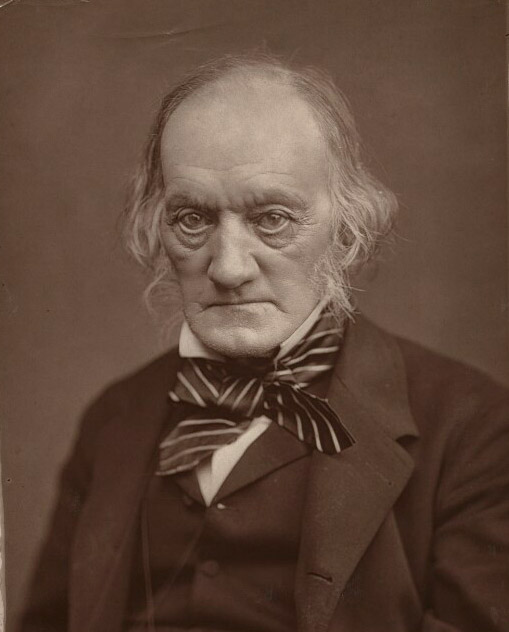
Owen was the first anatomist, after Petrus Camper, to distinguish decisively between the chimpanzee and the orangutan. He began studying the anatomy of non-human primates in the 1830s, when the Regent’s Park Zoo in London obtained its first orangutan (1830) and chimpanzee (1835). “Because of the primitive conditions of care under which the animals were held captive, they died from a few days to a few years after entering the zoo. To Owen, the cloud of these deaths had a silver lining in that the carcasses provided him an opportunity to dissect and describe the animals. His first zoological—as distinct from medical—paper was ‘On the anatomy of the orang-outang,’ presented to the Zoological Society in 1830; and in 1835 the death of the Society’s first chimpanzee enabled Owen to start his classic series on the comparative osteology of the orang and chimpanzee . . . His work on the chimps and orangs from Regent’s Park Zoo, combined with [his later work] on the Gabon gorillas . . . made Owen one of very few European authorities on primates and the foremost authority on primate osteology” (Rupke, Richard Owen, Victorian Naturalist, pp. 260; 262).
Browse Tags
Thematic Classifications
| Catalog Metadata | Reference Information |
|---|---|
| Entry Number | #14316 |
| Permanent Link | https://hom-sveltekit.fly.dev/entry/16641 |
| Author Bio Link | Wikipedia ↗ |
| External URL | on-the-osteology-of-the-chimpanzee-and-orang-utan |
Geographic Context
Mentioned in annotation: London