
Inborn errors of metabolism.
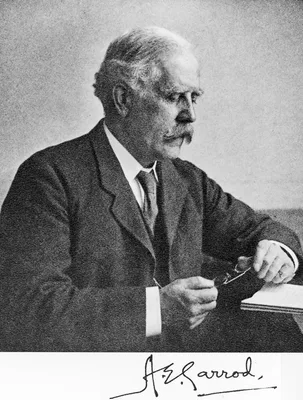
Publication Details
London: H. Frowde, 1909 CE.
Garrod established chemical individuality as a paradigm of Mendelian variation. His study, which he began around the turn of the 20th century, coincided with the rediscovery of Mendel's laws of inheritance in 1900. He realized that alkaptonuria (black urine disease) behaves like one of Mendel's recessive genetic traits, and guessed that people with alkaptonuria have a defective gene that produces a faulty enzyme that interrupts an important metabolic pathway. This was the first recognition of the possibility that genes direct the assembly of enzymes, and more specifically, that each gene codes for one enzyme. Over the next few years, Garrod discovered three more metabolic diseases that behave like recessive traits, including albinism. He showed that constitutional variation in function, as well as in structure, can give rise to what he termed “chemical malformations” – alkaptonuria, cystinuria, pentosuria, etc. The book was based on his Croonian Lectures, published in Lancet, 1908, 2, 1-7, 142-8, 173-9, 214-20. A second edition appeared in 1923. It was reprinted with supplement by H. Harris, London, 1963. Garrod’s first paper on the subject dealt with alkaptonuria (Lancet, 1901, 2, 1484-6).
Browse Tags
Thematic Classifications
| Catalog Metadata | Reference Information |
|---|---|
| Entry Number | #244.1 |
| Permanent Link | https://hom-sveltekit.fly.dev/entry/5049 |
| Author Bio Link | Wikipedia ↗ |
| External URL | inborn-errors-of-metabolism |
Geographic Context
Publication place: London