
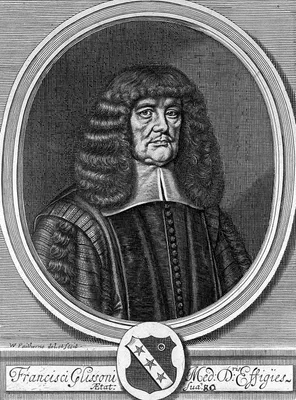
GLISSON, Francis (1597 – 1677)
1597 – 1677
5 entries in the GMN corpus.
Image source Line engraving by W. Faithorne, 1677, after himself [?]. (User Magnus Manske on en.wikipedia ) · Originally from en.wikipedia ; description page is (was) here 14:04, 8 July 2004 Magnus Manske 324x381 (39,946 bytes) ({{PD-old-100}} (PD by age)) · Public domain
1650 CE
#3729
De rachitide sive morbo puerili, qui vulgo The Rickets dicitur tractatus.
Although anticipated by Whistler and others in the description of infantile rickets, Glisson’s account was the fullest that had till then appeared. He was first (Chap. 22) to describe infantile scurvy. Glisson&r…
1654 CE
#1098.1
Anatomia hepatis … subjiciuntur nonnulla de lymphae-ductibus nuper repertis.
Independently of Bartholin and Rudbeck, George Joyliffe (1621-58) observed the lymphatics. He communicated his discovery to Glisson early in 1652 and the latter included an account in the above work (Cap. xxxi). See N…
1654 CE
#972
Anatomia hepatis.
First accurate description of the capsule of the liver (Glisson’s capsule) and its blood-supply. He also described the sphincter of the bile duct (“Glisson’s sphincter”, the sphincter of Oddi).…
1677 CE
#579
Tractatus de ventriculo et intestinis.
Glisson introduced the idea of irritability as a specific property of all human tissue, a hypothesis which had no effect upon contemporary physiology, but which was later demonstrated experimentally by Haller (No. 587).
1994 CE
#11506
English manuscripts of Francis Glisson (1): from Anatomia hepatis (The anatomy of the liver), 1654. Cambridge Wellcome Texts and Documents, no. 3. Edited by Andrew Cunningham.
Publishes for the first time the surviving partial English text of Glisson's book on the liver, and of the work's postscript on the lymphatic system. Glisson wrote in English, but his text was translated into Latin fo…