
![HIPPOCRATES, [Ἱπποκράτης; Hippocrates of Kos] (-460 – -370)](/media/portraits/50)
HIPPOCRATES, [Ἱπποκράτης; Hippocrates of Kos] (-460 – -370)
-460 – -370
64 entries in the GMN corpus.
Image source Unidentified engraver · 1881 Young Persons' Cyclopedia of Persons and Places Upload by RedWolf 05:45, Jan 10, 2005 (UTC) · Public domain
1998 CE
#10685
Oeuvres complètes, Tome VIII: Plaies, Nature des os, Coeur, Anatomie. Texte établi et traduit par Marie-Paul Duminil.
Greek text with facing French translation and study of four short treatises of the Hippocratic Collection on anatomy and traumatology of different periods and origins: On sores (probably 5th cent. BCE), On the nature …
2000 CE
#10013
Hippocrate, Oeuvres complètes, Tome IV, 3e partie: Epidémies V et VII. Texte établi, traduit et annoté par Jacques Jouanna. (Collection des universités de France). Commentaire médical par Mirko Grmek.
Epidemics V and VII are dated sometime around mid 4th century BCE, and compiled by a member of Hippocrates' circle.
2003 CE
#10018
Hippocrate, Oeuvres complètes, Tome II, 3ème partie: La maladie sacrée. Texte établi, traduit et annoté par Jacques Jouanna. (Collection des universités de France).
Until Hippocrates epilepsy was believed to be religious in origin; Hippocrates provided the first medical description of the disease.
2005 CE
#8301
Hippocrates On ancient medicine, translated with an introduction and commentary by Mark J. Schiefsky.
2008 CE
#10635
Hippocrate, tome XII, 1ère partie, Nature de la femme. Texte établi, traduit et annoté par Florence Boubon. (Collection des universités de France)
A gynecological treatise from the Hippocratic Collection. This one is supposed to come from the School of Cnidus or to use Cnidian material and is generally dated to mid 4th century BCE.
2011 CE
#13309
Novel medical and general Hebrew terminology from the 13th century. Translations by Hillel Ben Samuel of Verona, Moses Ben Samuel Ibn Tibbon, Shem Tov Ben Isaac of Tortosa, Zeraḥyah Ben Isaac Ben She’altiel Ḥen. Journal of Semitic Studies Supplement 27.
2012 CE
#12676
Epidemics in context: Greek commentaries on Hippocrates in the Arabic tradition. Edited by Peter E. Pormann.
2013 CE
#10638
Hippocrate, Oeuvres complètes, Tome III, 1re partie: Pronostic. Texte établi, traduit et annoté par Jacques Jouanna, Anargyros Anastasiou, and Caroline Magdelaine.
This treatise on prognostication in acute diseases was possibly written by Hippocrates himself; or if not, by a physician close to him, sometime during the second half of the 5th century, before 410 BCE.
2015 CE
#8431
The Hippocratic Corpus: Content and context.
2016 CE
#10012
Hippocrate, Oeuvres complètes, Tome IV, 1ère partie: Epidémies I et III. Texte établi, traduit et annoté par Jacques Jouanna. (Collection des universités de France.)
Greek text with facing French translation. Epidemics I and III, by a physician of Hippocrates' milieu, possibly by Hippocrates himself, sometime around 410 BCE
2017 CE
#11038
Hippocrate, Tome XII, 4e partie, Femmes stériles, Maladies des jeunes filles, Superfétation, Excision du foetus. Texte établi, traduit et annoté par Florence Bourbon.
Edition of the Greek text with facing French translation and commentary of four gynecological treatises from the Hippocratic Collection, from c. 470-350 BCE: De sterilibus = On sterility; De virginum morbis = On disea…
2017 CE
#12840
Reinventing Hippocrates. Edited by David Cantor.
"The name of Hippocrates has been invoked as an inspiration of medicine since antiquity, and medical practitioners have turned to Hippocrates for ethical and social standards. While most modern commentators accept tha…
2018 CE
#12625
The Cambridge companion to Hippocrates. Edited by Peter E. Pormann.
2020 CE
#13128
Maimonides, commentary on Hippocrates’ aphorisms: a new parallel Arabic-English edition and translation, with critical editions of the medieval Hebrew translations by Gerrit Bos. 2 vols. (The Medical Works of Moses Maimonides, Vols. 14.1, 14.2.)
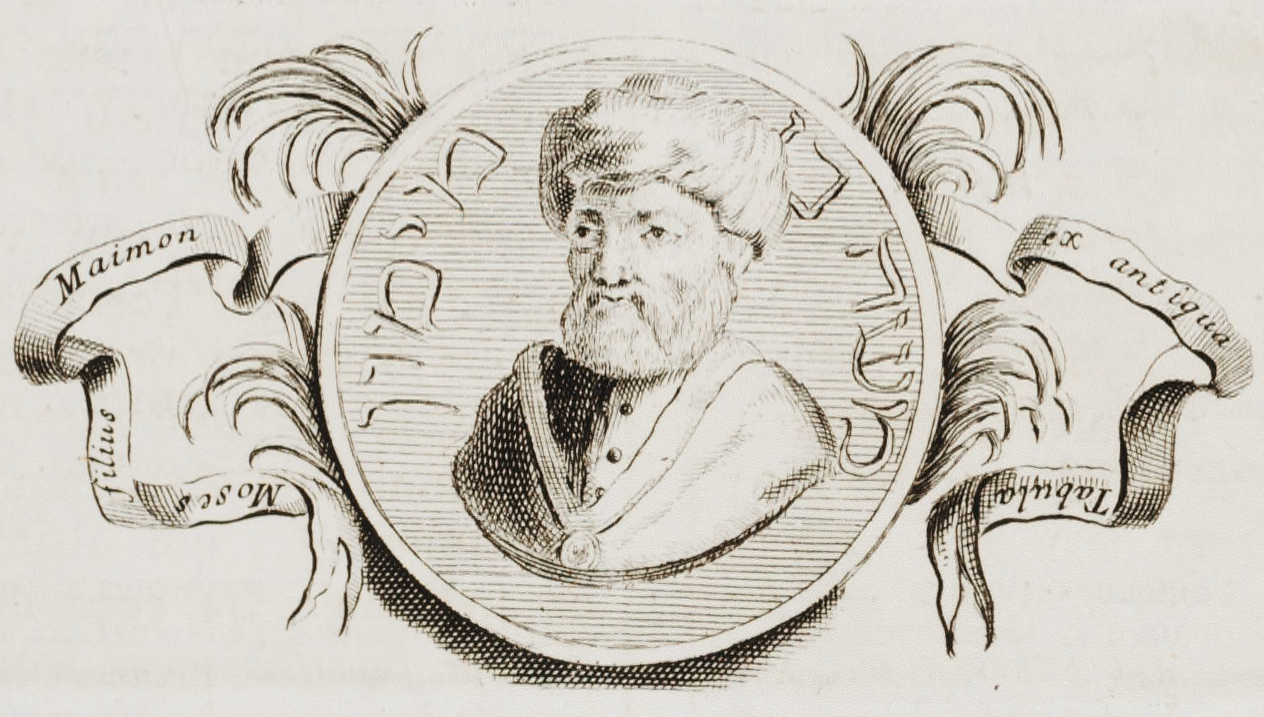
"Hippocrates’ Aphorisms enjoyed great popularity in the ancient and medieval world and, according to Maimonides, it was Hippocrates’ most useful work as it contained aphorisms, which every physician should…