
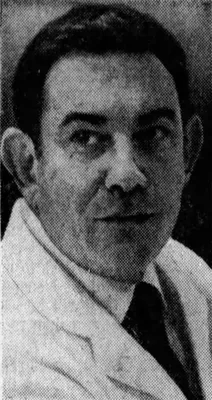
HAYFLICK, Leonard (1928 – 2024)
1928 – 2024
4 entries in the GMN corpus.
Image source Unknown author Unknown author · .mw-parser-output cite.citation{font-style:inherit;word-wrap:break-word}.mw-parser-output .citation q{quotes:"\"""\"""'""'"}.mw-parser-output .citation:target{background-color:rgba(0,127,255,0.133)}.mw-parser-output .id-lock-free.id-lock-free a{background:url("//upload.wikimedia.org/wikipedia/commons/6/65/Lock-green.svg")right 0.1em center/9px no-repeat}.mw-parser-output .id-lock-limited.id-lock-limited a,.mw-parser-output .id-lock-registration.id-lock-registration a{background:url("//upload.wikimedia.org/wikipedia/commons/d/d6/Lock-gray-alt-2.svg")right 0.1em center/9px no-repeat}.mw-parser-output .id-lock-subscription.id-lock-subscription a{background:url("//upload.wikimedia.org/wikipedia/commons/a/aa/Lock-red-alt-2.svg")right 0.1em center/9px no-repeat}.mw-parser-output .cs1-ws-icon a{background:url("//upload.wikimedia.org/wikipedia/commons/4/4c/Wikisource-logo.svg")right 0.1em center/12px no-repeat}body:not(.skin-timeless):not(.skin-minerva) .mw-parser-output .id-lock-free a,body:not(.skin-timeless):not(.skin-minerva) .mw-parser-output .id-lock-limited a,body:not(.skin-timeless):not(.skin-minerva) .mw-parser-output .id-lock-registration a,body:not(.skin-timeless):not(.skin-minerva) .mw-parser-output .id-lock-subscription a,body:not(.skin-timeless):not(.skin-minerva) .mw-parser-output .cs1-ws-icon a{background-size:contain;padding:0 1em 0 0}.mw-parser-output .cs1-code{color:inherit;background:inherit;border:none;padding:inherit}.mw-parser-output .cs1-hidden-error{display:none;color:var(--color-error,#bf3c2c)}.mw-parser-output .cs1-visible-error{color:var(--color-error,#bf3c2c)}.mw-parser-output .cs1-maint{display:none;color:#085;margin-left:0.3em}.mw-parser-output .cs1-kern-left{padding-left:0.2em}.mw-parser-output .cs1-kern-right{padding-right:0.2em}.mw-parser-output .citation .mw-selflink{font-weight:inherit}@media screen{.mw-parser-output .cs1-format{font-size:95%}html.skin-theme-clientpref-night .mw-parser-output .cs1-maint{color:#18911f}}@media screen and (prefers-color-scheme:dark){html.skin-theme-clientpref-os .mw-parser-output .cs1-maint{color:#18911f}} Goldstein, Lee Bennett (6 March 1975). " 'Old age' may be abolished" . The San Francisco Examiner . Women's News Service. p. 23 . Retrieved 1 November 2024 . · Public domain
1961 CE
#8381
The serial cultivation of human diploid cell strains.
The Hayflick limit. Hayflick demonstrated that a population of normal human fetal cells in a cell culture will divide between 40 and 60 times. The population then enters a senescence phase.
1962 CE
#3215.5
Growth on artificial medium of an agent associated with atypical pneumonia and its identification as a PPLO.
Using a novel agar and fluid medium formulation he had devised, Hayflick isolated a unique mycoplasma Mycoplasma pneumoniae, a mycoplasma shown to be the cause of some cases of primary atypical pneumonia, or "walking …
1970 CE
#8380
George A Sacher, Life table modification and life prolongation. IN: Handbook of the biology of aging, edited by Caleb E. Finch and Leonard Hayflick, pp. 582–638.
"The building of a connection between the Gompertz equation and the biology of ageing owes much to the work of biophysicist George Sacher [10] of the Argonne National Laboratory, whose introduction to ageing stemmed f…
2017 CE
#14102
The role of the WI-38 cell strain in saving lives and reducing morbidity.
In 1961 "Hayflick developed the first normal human diploid cell strains for studies on human aging and for research use throughout the world. Prior to his seminal research, all cultured cell lines were immortal and an…