
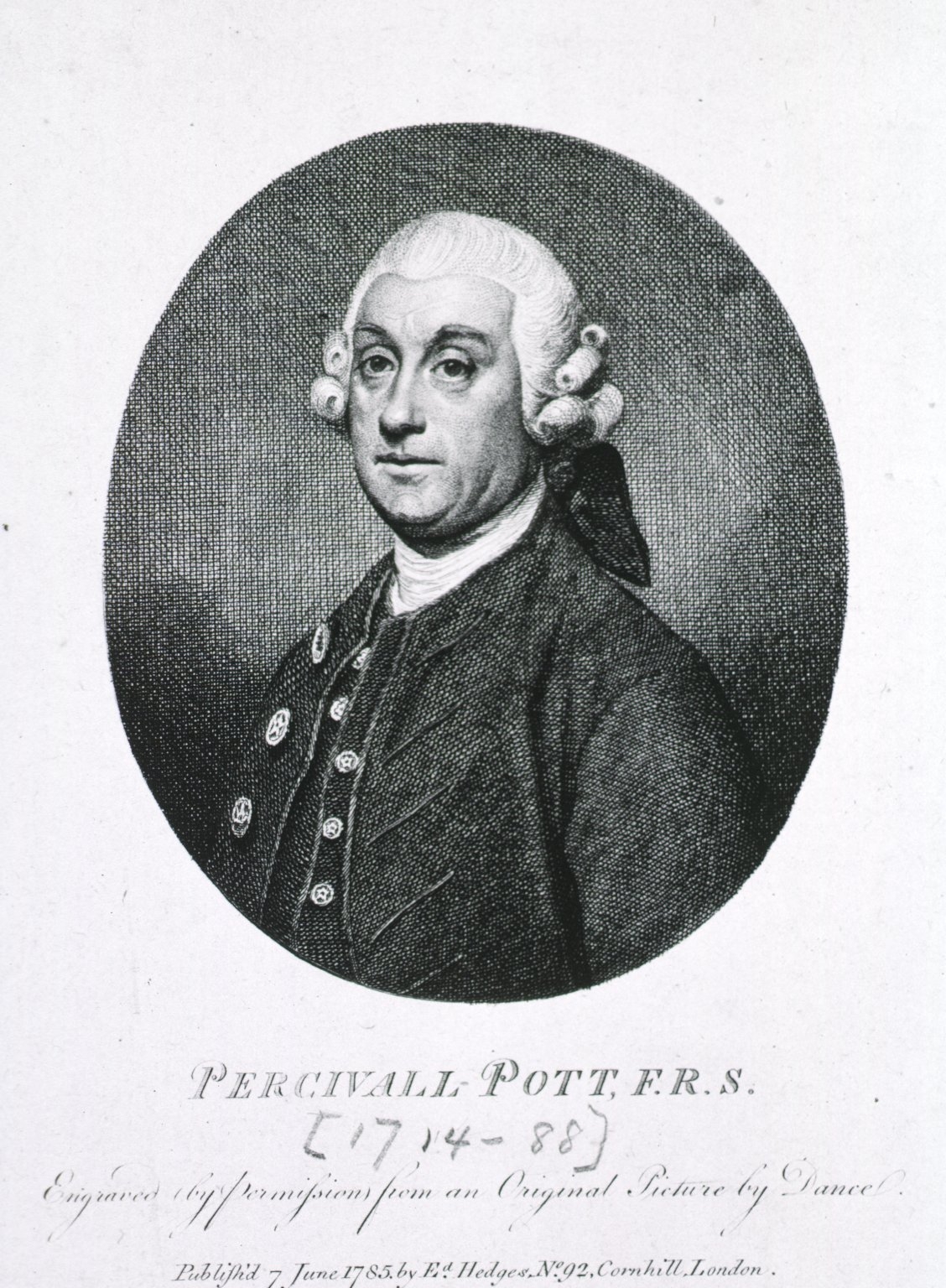
POTT, Percivall (1714 – 1788)
1714 – 1788
7 entries in the GMN corpus.
Image source After Nathaniel Dance-Holland · Published by Edward Hedges, London, 1785. · Public domain
1756 CE
#3576
A treatise on ruptures.
Pott was surgeon to St. Bartholomew’s Hospital. Through a fall in the street he was confined to bed for many days, and during that period wrote his classic book on hernia. He refuted many of the old theories con…
1760 CE
#4850.5
Observations on the nature and consequences of wounds and contusions of the head, fractures of the skull, concussions of the brain, etc.
This book, which showed Pott’s extensive knowledge of surgical literature, systematized the treatment of head injuries. It shows what a variety of injuries of the head could be sustained even before the advent o…
1762 CE
#4164
Practical remarks on the hydrocele or watry rupture.
Classic description of hydrocele.
1765 CE
#3424.2
Remarks on the disease commonly called a fistula in ano.
Probably the greatest English classic of colon-rectal surgery. Pott recommended the practice of simple division rather than the newer, more complicated methods proposed by Cheselden and Le Dran, and audaciously pointe…
1768 CE
#4408
Some few general remarks on fractures and dislocations.
The methods outlined by Pott in his classic work on fractures and dislocations were eventually adopted all over the world. He described (pp. 57-64) “Pott’s fracture” in this book, and he stressed the…
1775 CE
#2122
Chirurgical observations relative to the cataract, the polypus of the nose, the cancer of the scrotum, etc.
Includes the first description of occupational cancer. By describing chimney sweeps” cancer of the scrotum, Pott was the first to trace the origin of a type of cancer to a specific external cause. The above work…
1779 CE
#4304
Remarks on that kind of palsy of the lower limbs, which is frequently found to accompany a curvature of the spine.
“Pott’s disease”. Percival Pott, surgeon to St. Bartholomew’s Hospital for more than 40 years, left a classic description of spinal curvature due to tuberculous caries and causing paralysis of …