
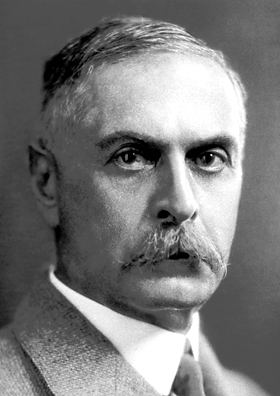
LANDSTEINER, Karl (1868 – 1943)
1868 – 1943
9 entries in the GMN corpus.
Image source Bachrach Studios · [2] · Public domain
1900 CE
#889
Zur Kenntniss der antifermentativen, lytischen und agglutinierenden Wirkungen des Blutserums und der Lymphe.
Also: Landsteiner, "Ueber Agglutinationsercheinungen normalen menschlichen Blutes," Wiener klinische Wochenschrift, 14, 1901, 1132-1134. Landsteiner discovered that human blood contains iso-agglutinins capable of aggl…
1904 CE
#2558.1
Über paroxysmale Hämoglobinurie.
The first description of an auto-antibody, and of an auto-immune disease, paroxysmal cold hemoglobinuria. See A.M. Silverstein, A history of immunology, New York, Academic Press, 1989, Ch. 8, The Donanth-Landsteiner a…
1906 CE
#2400
Zur Technik der Spirochaetenuntersuchung.
Dark field method of diagnosis for presence of T. pallidum.
1909 CE
#4669
Uebertragung der Poliomyelitis acuta auf Affen.
Landsteiner and Popper were the first to isolate poliovirus and to transmit poliomyelitis to monkeys.
1910 CE
#4670.3
La poliomyélite experimental.
Serum from a monkey that had recovered from experimental poliomyelitis was mixed with an emulsion containing active polio virus; it failed to produce paralytic disease when injected into fresh monkeys.
1927 CE
#910
A new agglutinable factor differentiating individual human bloods.
Discovery of M and N agglutinogens. See also the same journal, pp. 941-42.
1933 CE
#2576.2
Die Spezifizität der serologischen Reaktionen.
Summary of many years of research on antigen-antibody interactions. Landsteiner considered his study of hapten-antibody reactions to be his most significant work. Revised English translation, 1936 (revised 1945).
1940 CE
#912.2
An agglutinable factor in human blood recognized by immune sera for Rhesus blood.
Recognition of the Rh antigen
1942 CE
#2578.3
Experiments on transfer of cutaneous sensitivity to simple compounds.
Cellular transfer of delayed hypersensitivity, establishing the criticial role of mononuclear cells in cellular immunity.